Executive Brief: The Rheology of Toothpaste Formulation & Mixer Demands
Toothpaste manufacturing represents one of the most demanding sub-sectors of the chemical and oral hygiene engineering industries. Unlike simple liquid solutions or low-viscosity cosmetic lotions, toothpaste is a complex, highly viscous non-Newtonian fluid—specifically exhibiting pseudoplastic and thixotropic behaviors. The formulation typically consists of solid abrasive particles (such as colloidal silica, calcium carbonate, or hydrated alumina) suspended uniformly within a dense humectant liquid phase (sorbitol, glycerin, water) reinforced by binders, surfactants (like Sodium Lauryl Sulfate), active fluoride compounds, and flavorings.
To successfully compound these disparate raw ingredients into a smooth, stable, and bubble-free paste, the machinery must achieve rapid powder wetting, intensive shear dispersion, and robust micro-homogenization under high vacuum conditions. High-vacuum operation is crucial; entrained air bubbles not only ruin the product's aesthetic density but also initiate oxidation, which degrades key active therapeutic agents and shortens shelf life. Achieving this level of mechanical perfection cost-effectively is the core objective of modern discount toothpaste mixer suppliers & factories, who seek to deliver Western-grade engineering tolerances at competitive capital expenditure (CAPEX) margins.
Rheology Engineering
Overcoming shear-thinning resistance through optimized blade clearances, ensuring uniform gel structures without polymer chain degradation.
De-aeration Dynamics
Maintaining a constant vacuum level of down to -0.09 MPa to completely strip microscopic air pockets from high-viscosity paste matrices.
Agglomerate Breakdown
High-shear bottom or top homogenizers working up to 3600 RPM to disperse raw silica clusters into sub-micron active particles.
Global Commercial & Industrial Landscape
The global market for oral hygiene products has witnessed massive expansion, driven by rising dental health awareness in emerging markets and premiumization trend (such as charcoal-based, organic, and desensitizing toothpastes) in developed economies. Structurally, manufacturers are pressured by two opposing forces: the necessity to sustain high product quality and the intense price competition at retail levels. Consequently, capital expenditures on compounding lines have shifted under the microscope.
Historically, European machinery makers dominated the high-end industrial emulsification market. However, in the modern landscape, China-based manufacturers like SINAEKATO have bridged the technology gap. By sourcing approximately 80% of critical mechanical and electrical components from world-renowned global brands (such as Siemens PLCs, ABB motors, Schneider electronics, and Omron instruments), and marrying this hardware with cost-effective Chinese precision manufacturing, factories are now capable of providing state-of-the-art toothpaste mixing plants at a fraction of the cost of their Western competitors. This "Discount" positioning refers not to compromised quality, but to optimized production economics, local supply chain efficiencies, and streamlined engineering execution.
Industry Development Trends: Smart, Sustainable, & Modular
The contemporary toothpaste machinery landscape is evolving along several distinct vectors:
Continuous Mixing vs. Batch Mixing: While traditional batch vacuum mixers remain the gold standard for high-viscosity products due to precise batch verification, advanced factories are integrating semi-continuous setups. These systems use inline high-shear mixers to introduce powders into liquid phases instantly, reducing cycle times by up to 45%.
Energy Efficiency and Water Conservation: High-vacuum operations consume significant energy. Current generation mixers employ smart thermal jackets designed with spiral guides for optimized cooling/heating transfer, which lowers steam and chilled water consumption during the thermal cycling phase.
Industry 4.0 Integration: Toothpaste mixers are no longer stand-alone mechanical vessels. Modern factories require full integration into SCADA systems. Every batch's parameters—including vacuum levels, homogenizer RPM, impeller torque, temperature curves, and exact component weights—are tracked, logged, and audited in real-time, matching FDA Title 21 CFR Part 11 requirements.
These formulas utilize high ratios of calcium carbonate or hydrated silica. The mixer's contacting surfaces (typically SUS316L) must undergo special mirror polishing (roughness Ra < 0.4μm) and surface hardening treatment to withstand the extreme mechanical wear and prevent contamination from metal-shedding particles.
2. Herbal and Botanical Toothpastes
Highly popular in Asia and Africa (using neem, clove, or green tea extracts). These organic additives are highly heat-sensitive and must be introduced to the batch late via vacuum induction at lower temperatures (below 45°C) to prevent thermal degradation of active therapeutic compounds.
3. Transparent Gel Toothpastes
Gels demand absolute clarity, which means even micro-bubbles are visually unacceptable. The mixer must operate under a sustained deep vacuum throughout the entire gelation and cooling cycle, employing a specialized wall scraper system to ensure no localized overheating occurs near the jacket wall.
4. High-Fluoride & Medicated Formulations
Strict pharmaceutical protocols apply here. The mixer vessel must be designed to CIP/SIP (Clean-In-Place / Sterilize-In-Place) standards, eliminating any dead zones where residual paste could harbor bacterial growth or cross-contaminate subsequent batches.
Technology Roadmap: The Anatomy of a High-Performance Mixer
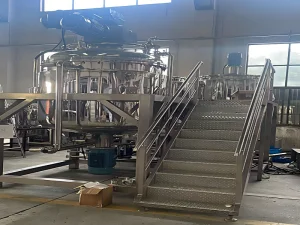
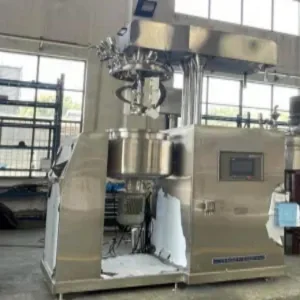
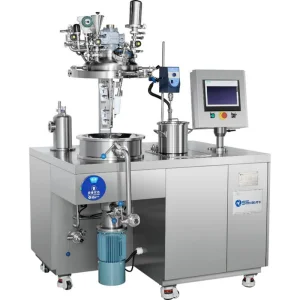
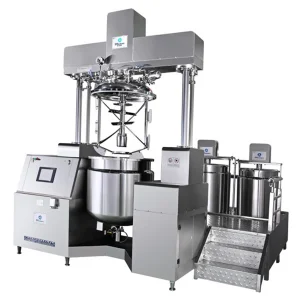
Achieving structural homogenizing homogeneity in a high-viscosity matrix requires a multi-axis physical mixing strategy. A typical high-performance vacuum toothpaste mixer utilizes three distinct, integrated agitating components:
1. The High-Shear Homogenizer (Bottom or Top Mounted): Operating at speeds up to 3000–3600 RPM, this unit forces the raw mixture through extremely narrow gaps between a high-speed rotor and a stationary stator. This subjects the fluid to intense mechanical shear, hydraulic force, and localized cavitation, instantly shattering powder agglomerates and dispersing binders like CMC (carboxymethyl cellulose) or Xanthan gum.
2. Counter-Rotating Anchor & Paddle Agitators: Running at lower speeds (15–60 RPM) in opposite directions, these impellers handle macro-blending. One paddle moves the material downward while the outer anchor sweep moves it upward, preventing stratification and ensuring a continuous cycle of fresh material passes through the high-shear zone.
3. Teflon Wall Scrapers: Positioned on the outer edges of the anchor agitator, these flexible scrapers continuously wipe the interior vessel wall. This removes the boundary layer of toothpaste, preventing localized overheating (which can ruin active compounds) and drastically improving heat transfer efficiency from the heating/cooling jacket.
Macro-Level Turnkey Industry Solutions
Modern toothpaste brands demand more than just a single standalone mixer. Industrial efficiency requires a fully integrated, streamlined production flow. A typical macro-solution provided by SINAEKATO encompasses several key stages, starting from raw ingredient processing to final product packaging:
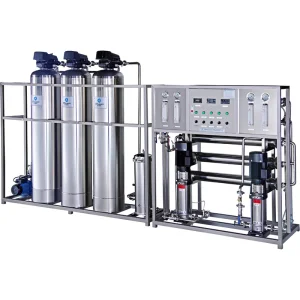
Water Purification Plant: Producing high-purity water is the critical first step. Industrial RO (Reverse Osmosis) Water Treatment Plants process municipal water to strip minerals, salts, and microbes, ensuring the water phase of the paste is pure and chemically stable.
Powder Charging Systems: Utilizing pneumatic vacuum transfer systems, powder ingredients like calcium carbonate, silica, and sorbitol are vacuumed directly into the mixing vessel from storage silos. This dust-free design prevents atmospheric contamination and ensures a clean, sanitary plant floor.
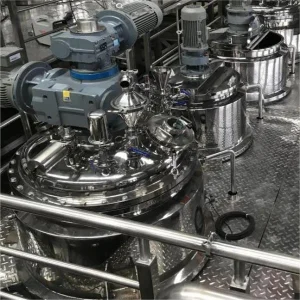
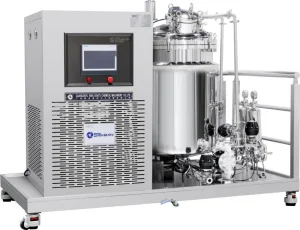
The Vacuum Compounding Phase: The core mixing process, where the gel matrix is formed, emulsified, and scrubbed of air under negative pressure.
Product Transfer & Storage: Using sanitary lobe pumps, the hot paste is transferred to SUS316L buffer/holding tanks. These tanks feature low-speed agitators to keep the paste homogeneous and prevent settling while cooling to packing temperature.
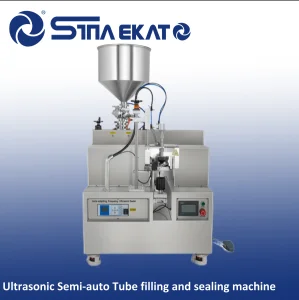
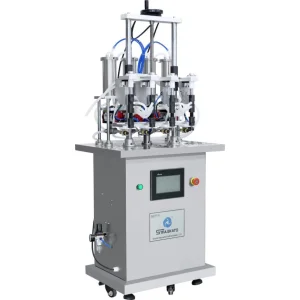
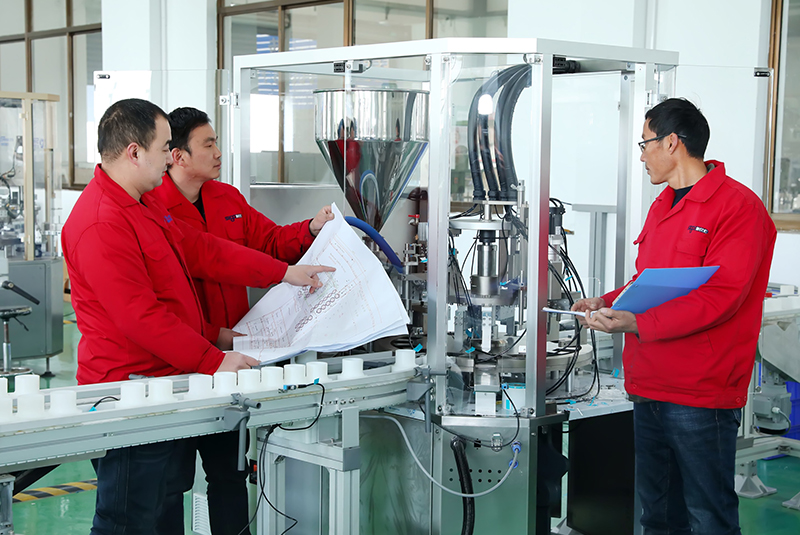
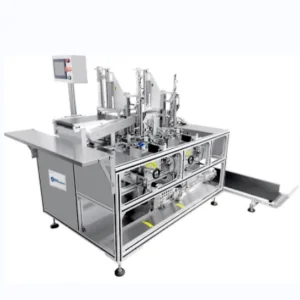
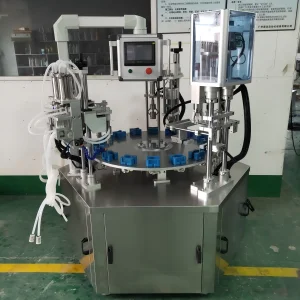
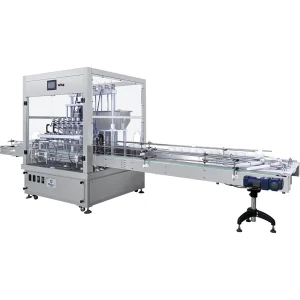
Packaging and Cartoning: Automatic tube filling and sealing machines (often using ultrasonic sealing for clean, crisp plastic tube finishes) fill the paste into tubes, code them with batch numbers, and transfer them to downstream cartoning machines for bulk packing.
Why Choose SINAEKATO?
Science and Technology are the primary productive forces; they are also the core competitiveness of enterprises. At SINAEKATO, we continuously strengthen the research, development, and innovation of core mixing technologies. We constantly strive for excellence by implementing advanced production equipment, strict quality management, and precise production testing processes to ensure the outstanding performance of each product. Choose SINAEKATO to secure professional technical support, robust mechanical warranties, and dependable long-term after-sale service.
Company History & Solid E-E-A-T Foundations
SINAEKATO's journey is a testament to over three decades of mechanical engineering evolution and global partnership success. Below is a detailed look at our key developmental milestones:
1988
Engaged and laid roots in the chemical machinery engineering sector, establishing foundational technical knowledge in liquid-solid mixing.
1998
Guangzhou Sina Cosmetics Engineering Equipment Co., Ltd. was officially established to serve the booming domestic cosmetic market.
1999
Established Hong Kong Hantao International Investment Co., Ltd., opening paths for overseas technology integration and global business relations.
2000
Gaoyou Sina Chemical Machinery Equipment Factory was established. Concurrently, the Guangzhou company officially transitioned to Guangzhou Sina Chemical Machinery Co., Ltd.
2001
Established Gaoyou Sina Light Industry Machinery Equipment Factory, expanding manufacturing capacity and widening our product portfolio.
2006
Purchased 10,000 square meters of industrial land in Gaoyou. The state-of-the-art processing plant was put into full operation under the name: SINA EKATO CHEMICAL MACHINERY CO., LTD (GAOYOU CITY).
2007
Established Yangzhou Hantao Chemical Machinery Co., Ltd., boosting regional supply chain depth.
2008
Acquisition of Guangzhou Jingcheng Machinery. Opened our large product exhibition center and officially launched structured export sales routes.
2009
Original Guangzhou company officially renamed to Guangzhou SINAEKATO Chemical Machinery Co., Ltd., cementing our modern brand identity.
2011
Acquisition of Guangzhou Suogao Machinery Equipment Co., Ltd., expanding technology patents in high-shear emulsification.
2013
Established SINA EKATO CHEMICAL MACHINERY CO., LTD (GAOYOU CITY) as the global headquarters for Production, Sales, and After-Sale Service.
2015
Established SINA EKATO Equipment (Jiangsu) Co., Ltd., focusing on foreign joint-venture engineering standards.
2017
Partnered with European brand FLEMAC to establish Germany SINAEKATO Group Co., Ltd., integrating advanced European engineering design philosophies.
2018
Partnered with Unilever South Africa on a cosmetic engineering line valued at $800,000 USD. Collaborated with Shiseido/SK-II OEM cosmetics producers on a $1,500,000 USD facility.
2021
Successfully delivered a $1,000,000 USD automated detergent liquid-washing project to Japanese cosmetic partners, validating our compliance with strict quality standards.
In-Depth Q&A (FAQ) for Procurement Managers
Q1: Why is vacuum level critical in toothpaste mixing, and what range do your machines maintain?
Toothpaste formulations contain thickeners like sodium carboxymethyl cellulose (CMC) and silica powders that trap microscopic air pockets. If mixed under atmospheric pressure, these micro-bubbles remain suspended, leading to package swelling, unstable paste viscosity, and rapid degradation of active ingredients (like Sodium Fluoride). Our mixers maintain a reliable working vacuum of -0.09 MPa to completely pull these micro-bubbles out of high-viscosity paste.
Q2: How do your mixers handle the abrasive nature of calcium carbonate and silica?
Abrasive wear is a primary concern for toothpaste mixers. We build all product-contacting surfaces from genuine SUS316L stainless steel. The interior of the mixing vessel is mirror-polished down to a roughness rating of Ra < 0.4μm. Additionally, we apply a localized surface hardening treatment to the high-shear homogenizer rotor/stator to prevent erosion and eliminate the risk of metal particulates shedding into the batch.
Q3: What makes a "Discount" mixer from SINAEKATO reliable compared to expensive European brands?
Our "Discount" pricing is achieved through local supply chain optimization and optimized assembly procedures in our 10,000 sqm Gaoyou facility. However, 80% of our key componentry is sourced from world-class suppliers (e.g., Siemens PLC, ABB motors, Omron components). This combines the best of both worlds: Western reliability and performance with the cost savings of Chinese precision manufacturing.
Q4: Are your toothpaste manufacturing lines compliant with GMP and FDA regulations?
Yes, all of our vacuum emulsifiers, storage vessels, and filling equipment conform to GMP, CE, and ISO certification requirements. The sanitary piping systems are self-draining, and the vessels are designed without blind corners. They can be fully integrated with clean-in-place (CIP) and sterilize-in-place (SIP) units to meet stringent pharmaceutical and cosmetic grade hygienic standards.
Q5: What capacity ranges do you supply for toothpaste production?
We offer standard production systems ranging from pilot/laboratory models (5L–50L) for formulation testing to large-scale industrial systems (100L up to 5000L). A typical high-volume production setup utilizes our 300L, 500L, or 1000L vacuum emulsifying mixers integrated with matching raw ingredient feed stations and automated packaging lines.
 Sina Ekato