30 Years Of Experience
3-7 Days Delivery
Reasonable Price & Best Service
CE Certificated Products
Advanced Technology
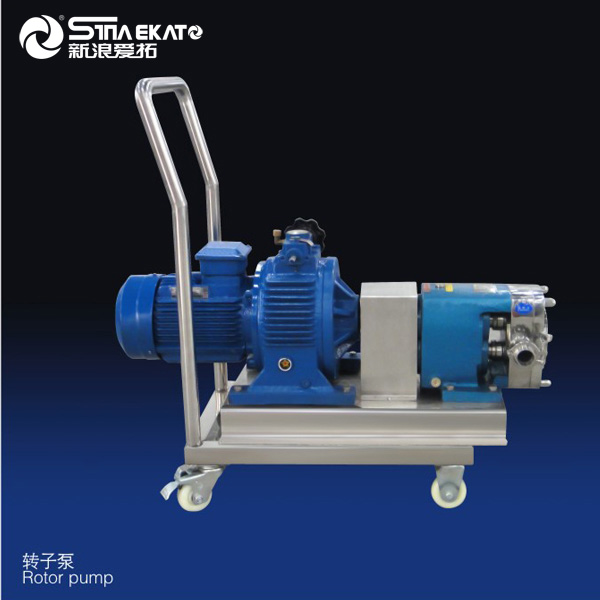
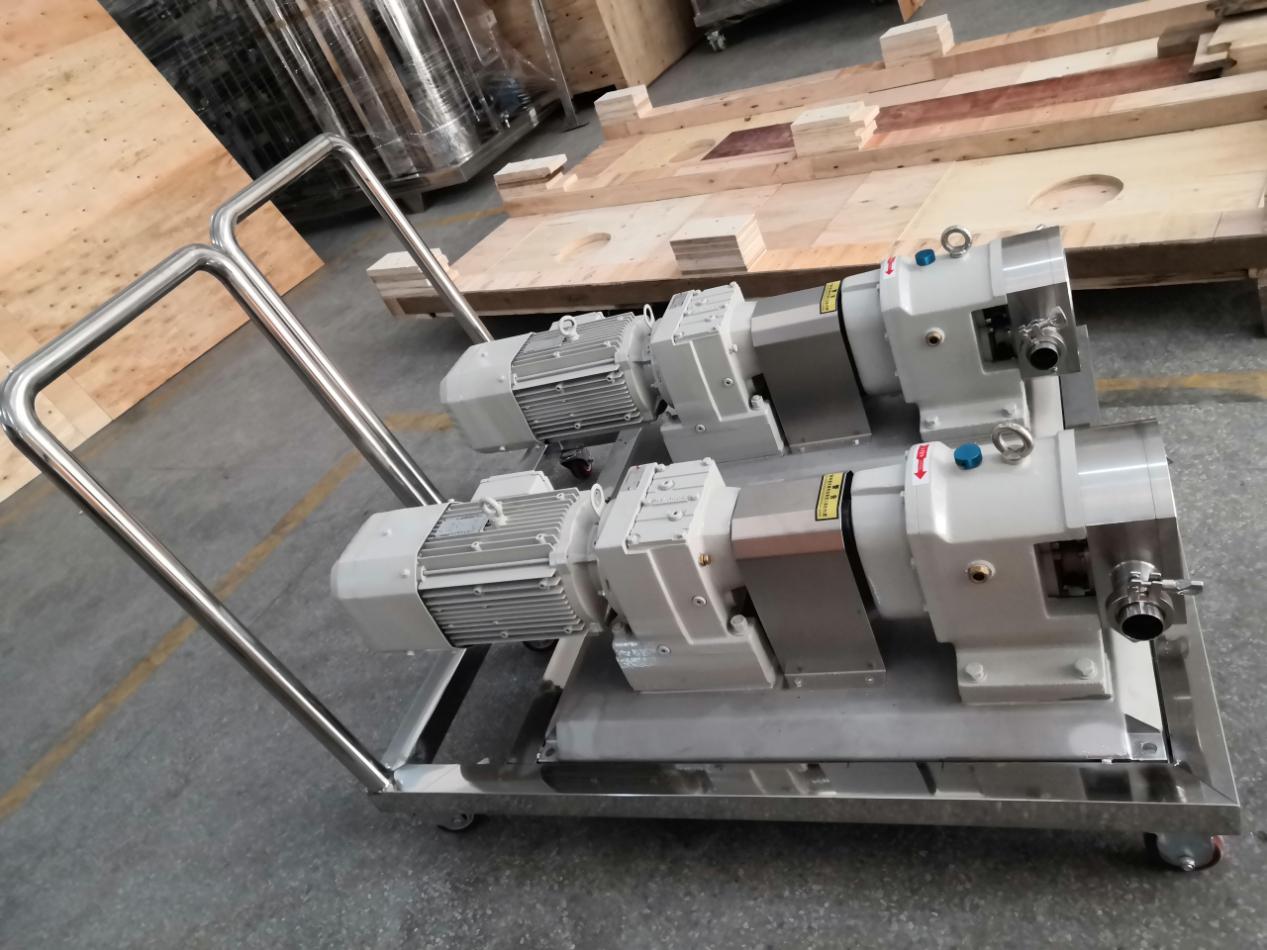
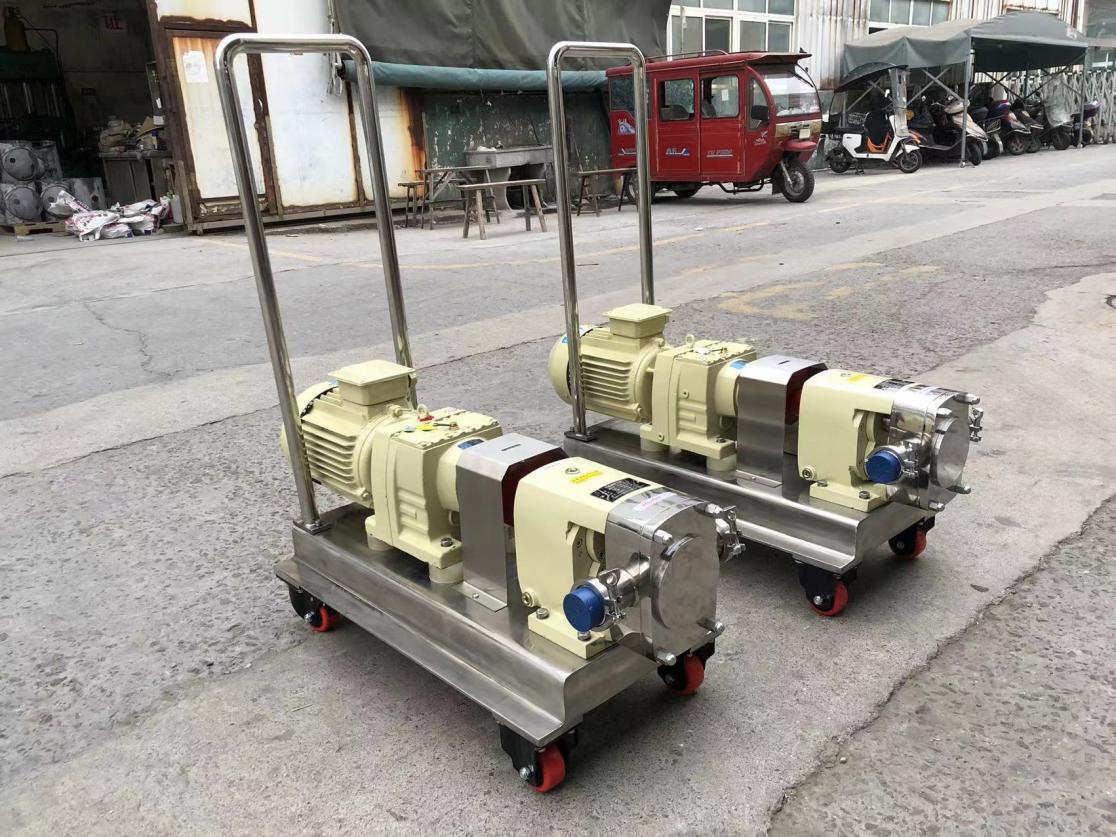
Rotor pump is also named rotary lobe pump, three-lobe pump, sole pump, etc. When the 2 simultaneous reverse rotating rotors (with 2-4 gears) revolve, it produces suction force at the inlet (vacuum), which intakes the material delivered.
Technical Specifications & Material
-
Specifications:
3T-200T, 0.55KW-22KW
-
Contact Material:
AISI316L stainless steel (part contact with medium)
-
Other Parts:
AISI304 stainless steel
-
Sealing Contact:
EPDM (with medium)
-
Standards:
DIN, SMS
-
Temp. Range:
-10°C - 140°C (EPDM)
Rotor Type Options
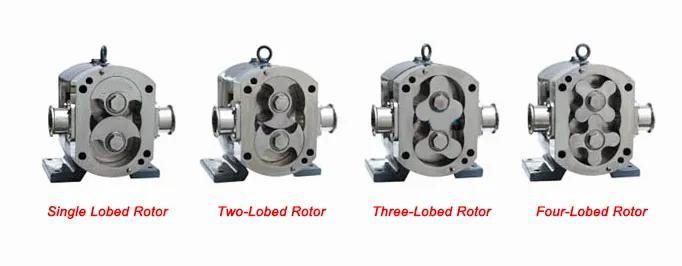
1. Single Lobed Rotor
More suitable for conveying media which containing large granular materials. The breaking rate of large granular materials is low. But on other hand it is not popular one for used, Because its pulsation is large and pressure is low, also the volume is small for the space of transferred materials.
2. Two-Lobed Rotor (Butterfly Rotor)
More suitable for conveying media which containing small and medium-size granular materials. The breaking rate to these materials is low and getting slightly pulsating. The volume is a little less than three-lobed rotor for the space of transferred materials.
3. Three-Lobed Rotor
It is widely used one rotor. The volume is bigger than other type of rotors for the space of transferred materials. Also each performance is higher than other rotors. Just it has a certain rate of breakage to the particulate materials on the transport way.
4. Multi-Lobed Rotor (4-12)
The volume is more smaller for the space of transferred materials and breaking rate more higher when the quantity of rotary vane of rotor be increased. Just the transport way more stable.
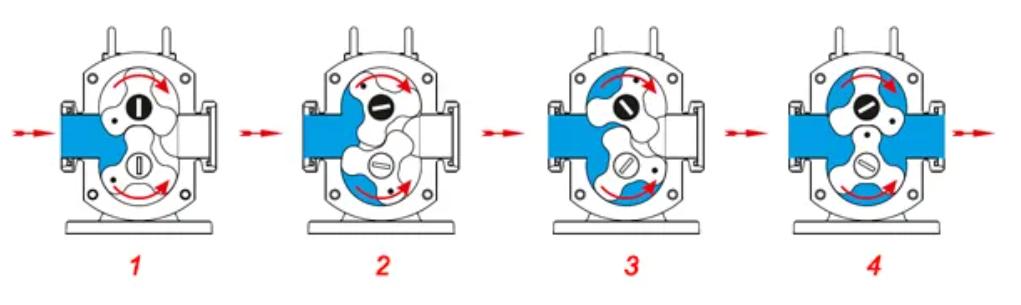
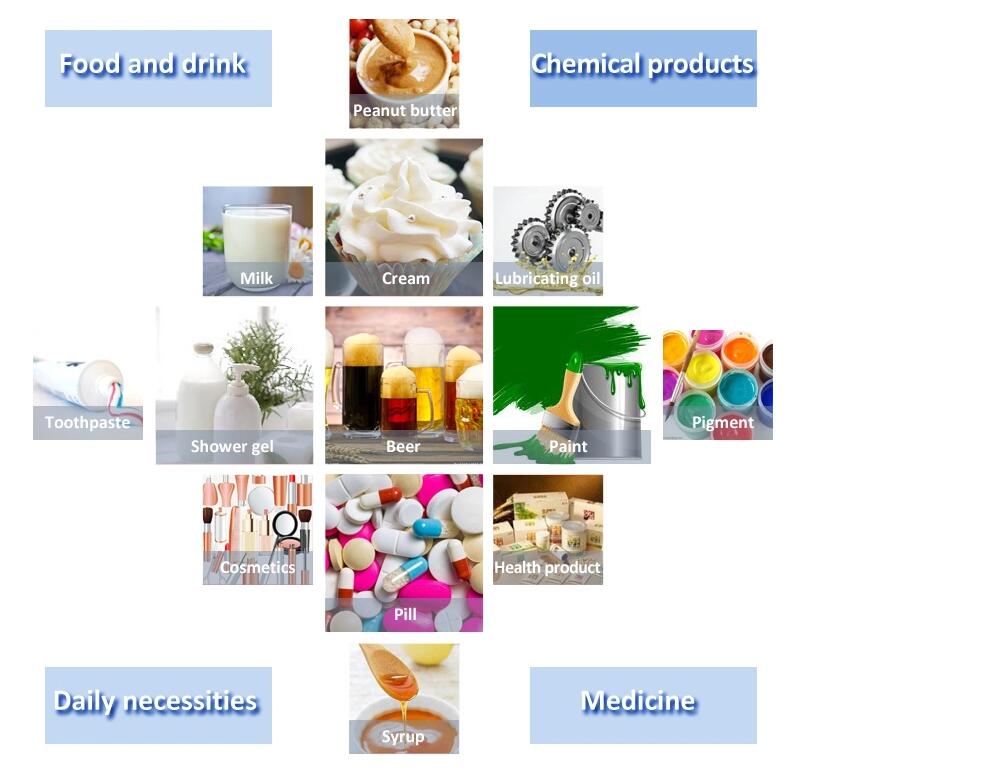
The rotary lobe pumps we also called them lobe rotor pumps. They are one popular transfer pump to conveying the food, beverage, pulp and paper, chemical, pharmaceutical and so on. The rotor lobe pump relies on two synchronously rotating rotors that generate suction (vacuum) at the inlet during the rotation. Thereby sucking in the material to be conveyed. Both rotors split the rotor chamber into different spaces. Then operate in the order of 1-2-3-4. The medium is delivered to the discharge port. In this cycle, the medium (material) is continuously transported out by the source.
Performance Specifications
| Flow (per 100 rotation) |
Suggested rotation speed (RPM) |
Capacity (L-H) |
Power (KW) |
| 3 |
200-500 |
300-800 |
0.55 |
| 6 |
200-500 |
650-1600 |
0.75 |
| 8 |
200-500 |
850-2160 |
1.5 |
| 12 |
200-500 |
1300-3200 |
2.2 |
| 20 |
200-500 |
2100-5400 |
3 |
| 30 |
200-400 |
3200-6400 |
4 |
| 36 |
200-400 |
3800-7600 |
4 |
| 52 |
200-400 |
5600-11000 |
5.5 |
| 66 |
200-400 |
7100-14000 |
7.5 |
| 78 |
200-400 |
9000-18000 |
7.5 |
| 100 |
200-400 |
10000-22000 |
11 |
| 135 |
200-400 |
15000-30000 |
15 |
Key Features & Advantages
- There is a certain gap between rotor and rotor, no friction coefficient, so the pump has a long service life time.
- It is easy to install and disassemble, and it is convenient to maintain and clean. There are fewer wearing parts.
- High efficiency and energy saving, stable transportation, low failure rate, no leak sealing, and low noise.
- The viscosity of the transportable medium is ≤ 2,000,000 Cp, and the pump can transfer slurry containing 70% solids.
- It can transport gas, liquid, and solid three-phase mixture materials.
- With VFD (Variable Frequency Drive), the flow can be adjusted at will, and the pump can be used as a general metering pump.
- If needed, we can design the pump with a heating jacket.
- Applicable temperature range: -50°C to 250°C.
- Types of inlet/outlet connections: Flange joint, threaded connection, or quick connection.
- Seal options: Mechanical seal and packing seal.
Applicable Industries
Food Industry
Wine, olive oil, vegetable oil, molasses, pressed olive waste, fermented grapes, glucose, tomato concentrate, chocolate.
Industrial & Wastewater
Sludge, slurries, manure, effluent, crude oil, glue, inks, paint, fuel oil. Wastewater treatment, membrane bioreactor filtration (MBR), effluent, sewage.
Mining, Oil, Gas & Pharma
Bentonite, ceramic slips, calcium carbonate. Seawater, crude oil products, oily sludge, marine spills, mud. Detergents, surfactants, glycerine.
Frequently Asked Questions (FAQ)
Q How does a rotary lobe pump operate?
The pump relies on two synchronously rotating rotors that generate a vacuum suction force at the inlet. As they rotate, they split the rotor chamber into different spaces, drawing in the material and continuously delivering it to the discharge port.
Q What materials are used in the construction of these pumps?
Parts that come into direct contact with the medium are made of high-quality AISI316L stainless steel. Other parts are constructed from AISI304 stainless steel, and the sealing contact is made of EPDM.
Q What is the difference between single, two-lobed, and three-lobed rotors?
Single-lobed rotors are best for large granular media with low breakage rates. Two-lobed (butterfly) rotors are suited for medium-sized particles with low pulsation. Three-lobed rotors are the most popular, providing higher volume capacity and performance, though they have a higher particle breakage rate.
Q Can the pump handle high-viscosity materials and solids?
Yes, these pumps can handle highly viscous media up to 2,000,000 Cp and are capable of transferring slurries containing up to 70% solids, as well as gas, liquid, and solid three-phase mixtures.
Q What are the available connection and sealing types?
The pumps support flange joints, threaded connections, and quick connections. For sealing, you can choose between mechanical seals and packing seals depending on your application requirements.
Q Is the flow rate adjustable?
Yes, when paired with a VFD (Variable Frequency Drive), the flow rate can be adjusted freely, allowing the pump to function as a general metering pump.