
How to Source the Best Small Plastic Water Tank?

Time:2026-09-22 Author:Ethan
0%

Sourcing the best small plastic water tank begins with a clear understanding of use, water quality, and installation conditions. The term “Small Water Tank Plastic” may describe many products, but their performance can differ greatly. A household tank for rooftop storage faces heat, wind, and ultraviolet exposure. A compact agricultural tank may need stronger walls and wider access openings. Define the application before comparing prices.

The United Nations World Water Development Report 2024 highlights growing pressure on freshwater systems and the importance of resilient water management. This context makes dependable storage more valuable, even for small facilities. The World Health Organization’s Guidelines for Drinking-water Quality recommends materials that do not introduce harmful substances into stored water. Therefore, buyers should request food-contact documentation, resin information, and test records from suppliers. Look for polyethylene designed for potable water, not merely recycled plastic with unclear origins.

Standards matter.

A tank supplier should explain wall thickness, rotational-molding quality, UV stabilization, fittings, and expected service life. NSF/ANSI/CAN 61 certification can support confidence for drinking-water applications, where applicable to the market. Still, certification alone does not replace factory inspection. Ask for production samples, dimensional drawings, leak-testing procedures, and photographs of actual installations. A low quotation may hide thin walls, weak lids, or incompatible valves. That mistake becomes expensive after transport or a hot summer.

I would also examine the supplier’s experience with similar climates and delivery routes. Request references, warranty terms, and replacement-part availability. The best choice is rarely the largest tank or the cheapest one. It is the product whose material, design, documentation, and support match the real operating environment.
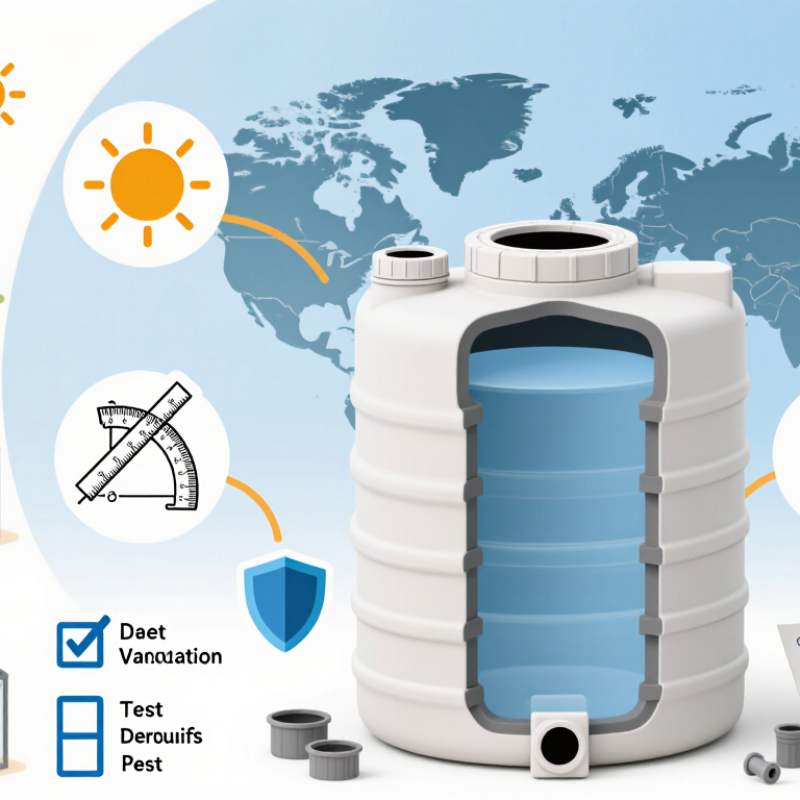
How to Source the Best Small Plastic Water Tank?

Set Capacity: 1,000 L of Water Equals Approximately 1 Metric Ton

How to Source the Best Small Plastic Water Tank?

A 1,000-liter water tank holds approximately one metric ton of water. At normal conditions, the exact mass is slightly below 1,000 kilograms. For sourcing, treat it as a one-ton load. The tank, fittings, and support frame add extra weight. Your floor or platform must carry everything safely. I have seen buyers focus on volume and overlook the base. That mistake can become expensive.

Check the tank’s working capacity, not only its advertised size. Leave headspace for expansion, movement, and safe filling. A tank marked 1,000 liters may offer less usable water in practice. Review the plastic type, wall thickness, UV resistance, and temperature range. For drinking water, request material documentation and test records. Strong molded seams matter. So do accessible outlets. Poorly positioned fittings can make cleaning frustrating.

Tips:

Compare the full operating weight before ordering. Choose a level, reinforced surface. Confirm delivery access, inlet height, outlet size, and drainage options. Ask how the tank performs under sunlight and repeated filling. A dark tank may reduce light exposure, but color alone proves little. I would also inspect the warranty terms carefully. They are often vague. Good technical advice should be specific, verifiable, and suited to your site.

Compare HDPE Resins by 0.94–0.97 g/cm³ Density and UV Stability

How to Source the Best Small Plastic Water Tank?

Density is a practical starting point when comparing HDPE resins. ISO 1183-1 and ASTM D1505 commonly place HDPE near 0.94–0.97 g/cm³. Lower-density grades can improve impact flexibility. Higher-density grades usually offer greater stiffness and chemical resistance. That difference matters.

For a small outdoor tank, density alone is not enough. Resin molecular weight, wall thickness, weld quality, and pigment loading also affect service life. A 0.96 g/cm³ resin may perform poorly if its UV package is weak. The ASTM G154 method commonly uses 340 nm ultraviolet exposure at 0.89 W/m²/nm, followed by condensation cycles. This test compares formulations, but it does not promise a fixed outdoor lifetime. Ask for test duration, color retention, tensile-strength loss, and certification details.

I prefer tanks made with UV-stabilized, food-contact-suitable HDPE, especially for exposed rooftops. Carbon black can provide strong UV protection, yet it may hide early surface damage. Light-colored tanks need careful stabilizer verification. In field checks, I inspect chalking, brittleness, seam distortion, and cap fit after sun exposure. Small details matter. A supplier should provide resin density, UV-weathering results, and batch traceability. However, paperwork is not proof of perfect molding. Temperature cycling, standing water pressure, and installation support still deserve a physical inspection.

How to Source the Best Small Plastic Water Tank?

Typical HDPE resin density points from 0.94–0.97 g/cm³, compared by outdoor UV-protection approach.

Higher density generally indicates greater crystallinity and can support stiffness and chemical resistance, but density alone does not determine outdoor service life. For water tanks exposed to sunlight, select a resin with a verified UV package or approximately 2–3% carbon black, and request weathering data from the supplier. The values shown are representative engineering points rather than company-specific grades.

Verify Potable-Water Compliance Under NSF/ANSI/CAN 61 and FDA 21 CFR 177.1520

How to Source the Best Small Plastic Water Tank?

Potable-water compliance should guide your shortlist, not tank size alone. The WHO/UNICEF Joint Monitoring Programme reported that 2.2 billion people lacked safely managed drinking water in 2022. That figure makes material safety more than a purchasing detail. Ask for current NSF/ANSI/CAN 61 certification or an equivalent, clearly covering the tank, fittings, seals, and intended water temperature. Certification should match the exact model and resin, not merely the factory’s product family.

FDA 21 CFR 177.1520 covers olefin polymers used with food, under defined conditions of use. It does not automatically approve every finished tank. Request the resin declaration, migration-test records, and temperature limits. Check whether the tank uses virgin, food-contact resin, or recycled material. A clean interior is important, but it proves little without documented testing. In practice, vague certificates often slow technical review. I have seen attractive tanks fail scrutiny because their fittings lacked separate compliance evidence.

Tips: Ask for the certificate number, test date, resin grade, and installation conditions. Inspect a cutaway sample for uniform wall thickness and smooth seams. Confirm UV, pressure, and cleaning limits in writing. Industry data can inform risk, but supplier documents require judgment. Even a respected laboratory report may not cover your actual water chemistry. That uncomfortable gap deserves attention.

Audit Rotomolding Quality Using ASTM D1998, ASTM G154, and Leak Tests

How to Source the Best Small Plastic Water Tank?

A small tank still needs disciplined quality control. The WHO/UNICEF JMP 2023 report estimated that 2.2 billion people lacked safely managed drinking water. EPA’s 2023 infrastructure assessment also projected $625 billion in drinking-water needs over 20 years. These figures make tank reliability more than a purchasing detail.

Production Quality Control

Ask the supplier to audit production against ASTM D1998. Check polyethylene grade, UV stabilizer documentation, molded seams, fittings, and wall-thickness records. Use ultrasonic mapping at the base, corners, and outlet area. Thin spots often hide there. ASTM D1998 is a strong benchmark, but it does not replace factory judgment. That matters.

For outdoor service, request ASTM G154 exposure records. Review lamp type, cycle settings, exposure hours, and changes in color, cracking, tensile strength, or impact performance. Do not accept “UV resistant” as proof. The test duration must match the tank’s climate and expected service life. Then require a water-fill leak test. Inspect every fitting and seam under a measured holding period. Record water level before and after testing.

Inspection Beyond Documentation

I would also request batch photos and rejected-part records. They reveal process discipline. Yet records can be incomplete. A clean report is not always a perfect tank. Pair documents with a sample inspection, dimensional checks, and a practical installation review. A tank can pass the factory test and still fail after poor support or overtightened fittings.

Evaluate MOQ, Delivered Cost, Lead Time, Warranty, and Spare-Part Support

Sourcing a small plastic water tank starts with MOQ, not the catalogue photo. A 500-unit MOQ may reduce the unit price, yet it can trap cash in slow-moving stock. Ask for pricing at 50, 100, and 500 units. Also check mold fees, inspection charges, inland freight, customs, and final delivery. UNCTAD’s Review of Maritime Transport 2023 reports that ships carry over 80% of global merchandise trade, so freight volatility can quickly change the delivered cost.

Lead time needs a written breakdown. Separate mold preparation, production, testing, packing, and shipping. A supplier promising 15 days may mean only factory production. Request a sample schedule with actual dates. Plastic resin exposure also matters. PlasticsEurope reported global plastics production of about 400.3 million tonnes in 2022, showing the scale of a market influenced by material-price movement. I would compare delivered cost using the same resin specification, wall thickness, tank capacity, and delivery address. Small differences can become expensive.

Warranty language should cover leakage, cracking, fitting failure, and color degradation. Ask how claims are inspected and who pays replacement freight. Spare-part support is equally practical. Keep a list of lids, valves, gaskets, brackets, and their prices. A two-year warranty is weak if a low-cost gasket takes eight weeks to arrive. Request test records, material declarations, and quality procedures aligned with ISO 9001 principles. I would not rely on certificates alone. Inspect one tank under real handling conditions, because a perfect sample can still hide inconsistent production.

FAQS

What quality standard should guide a small plastic water tank audit?

Use ASTM D1998 as a practical benchmark. Check polyethylene grade, UV stabilizer records, seams, fittings, and wall thickness. It does not replace careful factory judgment.

Where should wall thickness be measured?

Use ultrasonic mapping at the base, corners, and outlet area. Thin spots often hide there. A catalogue specification is not enough.

How can outdoor durability be evaluated?

Request ASTM G154 exposure records. Review lamp type, cycle settings, and exposure hours. Check color change, cracking, tensile strength, and impact performance.

Is a “UV resistant” claim sufficient?

No. Ask for test evidence matching the tank’s climate and expected service life. The phrase sounds reassuring, but it proves very little alone.

What leak test should a supplier perform?

Require a water-fill test with a measured holding period. Record the water level before and after testing. Inspect every fitting and seam closely.

Which purchasing costs should be compared?

Compare prices at 50, 100, and 500 units. Include mold fees, inspection, inland freight, customs, and final delivery. The cheapest unit may create expensive leftover stock.

How should production lead time be checked?

Request dates for mold preparation, production, testing, packing, and shipping. A promised 15-day schedule may exclude transport. That distinction matters.

What should the warranty and spare-parts plan cover?

Confirm coverage for leakage, cracking, fitting failure, and color degradation. Check replacement freight responsibilities. Keep prices and delivery times for lids, valves, gaskets, and brackets.

Can certificates and factory records prove consistent quality?

Not completely. Request batch photos and rejected-part records, then inspect a sample tank. A clean report can still hide inconsistent production.

What installation risks should be reviewed?

Check support conditions and fitting tightness before use. Poor support can damage a tank after testing. Overtightened fittings can also cause failure.

Conclusion

Sourcing the best Small Water Tank Plastic requires more than comparing price and appearance. Start by defining the required capacity: 1,000 liters of water weighs approximately one metric ton, so the tank, base, and installation area must safely support the filled load. Next, compare high-density polyethylene (HDPE) materials by checking resin density, typically around 0.94–0.97 g/cm³, along with UV stability for outdoor use. For drinking-water applications, request documentation showing compliance with NSF/ANSI/CAN 61 and FDA 21 CFR 177.1520.

Quality should also be verified through rotomolding inspections, including wall-thickness consistency, dimensional accuracy, ASTM D1998 evaluation, ASTM G154 UV testing, and practical leak tests. Finally, assess the supplier’s minimum order quantity, delivered cost, production and shipping lead time, warranty terms, and availability of replacement fittings or spare parts. A dependable decision balances safety, durability, total ownership cost, and long-term service support rather than focusing only on the initial purchase price.

Ethan

Ethan

Ethan is a seasoned marketing professional with a deep expertise in our company's innovative product line. With a passion for sharing knowledge and insights, he takes the lead in regularly updating our corporate blog, where he explores industry trends, product features, and effective marketing......